Shop > Anthologies
#14854
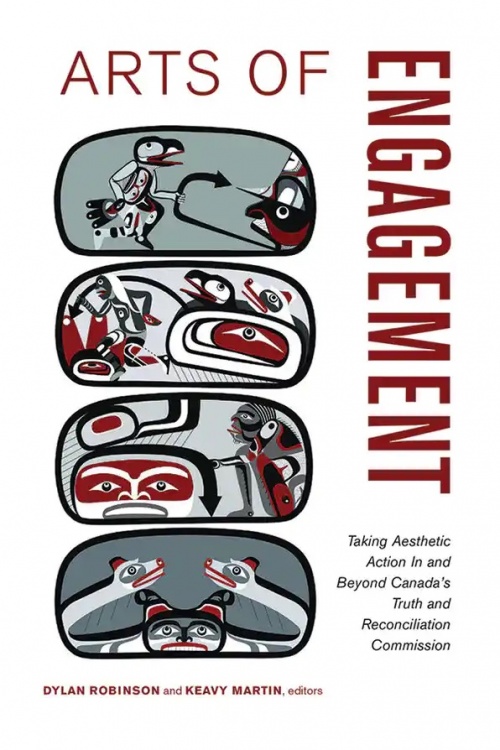
Arts of Engagement: Taking Aesthetic Action In and Beyond the Truth and Reconciliation Commission of Canada
- Editors
- Dylan Robinson and Keavy Martin
- Date
- 2016
- Publisher
- Wilfrid Laurier University Press
- Format
- Anthologies
- ISBN
- 9781771121699
- Size
- 15.3 × 22.9 cm
- Length
- 382 pp
- Genre
- Theory, Indigenous Art & Artists, Politics, Essays
Arts of Engagement focuses on the role that music, film, visual art, and Indigenous cultural practices play in and beyond Canada’s Truth and Reconciliation Commission on Indian Residential Schools. Contributors here examine the impact of aesthetic and sensory experience in residential school history, at TRC national and community events, and in artwork and exhibitions not affiliated with the TRC. Using the framework of “aesthetic action,” the essays expand the frame of aesthetics to include visual, aural, and kinetic sensory experience, and question the ways in which key components of reconciliation such as apology and witnessing have social and political effects for residential school survivors, intergenerational survivors, and settler publics.
This volume makes an important contribution to the discourse on reconciliation in Canada by examining how aesthetic and sensory interventions offer alternative forms of political action and healing. These forms of aesthetic action encompass both sensory appeals to empathize and invitations to join together in alliance and new relationships as well as refusals to follow the normative scripts of reconciliation. Such refusals are important in their assertion of new terms for conciliation, terms that resist the imperatives of reconciliation as a form of resolution.
This collection charts new ground by detailing the aesthetic grammars of reconciliation and conciliation. The authors document the efficacies of the TRC for the various Indigenous and settler publics it has addressed, and consider the future aesthetic actions that must be taken in order to move beyond what many have identified as the TRC’s political limitations.
Related Items





- Art Metropole
- 896 College St
- Toronto, Ontario
- M6H 1A4 Canada
- +1 416 703 4400
- Hours:
- Tuesday to Sunday
- 11AM to 6PM
Art Metropole is a non-profit artist-run centre established 1974 as a division of Art-Official Inc. We are grateful for the support of the Canada Council for the Arts, the Ontario Arts Council, the City of Toronto through the Toronto Arts Council, as well as our donors, members and volunteers.
Your donation assists in the development of contemporary art practices and programs for the general public. Art Metropole is certified by the Ontario Living Wage Network.
- Toronto Arts Council
- Ontario Trillium Foundation
- Canada Council
- Ontario Arts Council
