Shop > Monographs
#15051
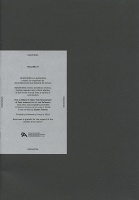
Alighiero e Boetti: Mappa
- Artist
- Alighiero e Boetti
- Writer
- Luca Cerizza
- Date
- 2008
- Publisher
- Afterall Books
- Format
- Monographs
- ISBN
- 9781846380273
- Size
- 15 × 21 × 1 cm
- Length
- 109 pp
- Genre
- Criticism
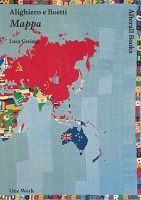
In 1968, the Italian artist Alighiero Boetti renamed himself Alighiero e (“and”) Boetti, effectively expressing the duality of his personality and his work—and, by extension, the dichotomies of society and culture and art and life. Boetti was a central figure in the arte povera movement, a group of Italian artists in the late 1960s who expressly distanced themselves from commercialization and the slickness of Pop Art. These artists worked with a wide range of nonconventional materials—from wool and vegetables to silk and dirt. This illustrated study examines Boetti’s 1988 work Map (or Mappa), one of the artist’s series of woven tapestry maps of the world. In the cartography of this Map, each country is depicted by its flag; its pre-postcommunist picture of the world shows the Soviet Union as a vast expanse of red in the upper eastern corner, projecting the last image of a long-failed socialist utopia. Opposed to “the myth of originality,” Boetti saw his role as that of triggering a work of art rather than executing it. Map (and the rest of the series) was based on a schema designed by Boetti’s friend and collaborator Rinaldo Rossi and embroidered by a team of craftswomen in Kabul, Aghanistan. The finished work, with its brightly colored, painstakingly woven national flags, transforms the rigid norms of state division into a maze of colors. Map offers not just the beauty of a handcrafted carpet but a movingly interwoven pattern of interdependence that the world too often fails to recognize.
Pier Luigi Tazzi is a critic, lecturer, and curator, currently based in Capalle, Italy. Alighiero e Boetti (1940-1994) was a central figure of the arte povera movement of radical Italian artists in the 1960s.
Related Items
![Stephen Wetzel: [PAUSE]](https://artmetropole.com/image/14716/t)

- Art Metropole
- 896 College St
- Toronto, Ontario
- M6H 1A4 Canada
- +1 416 703 4400
- Hours:
- Tuesday to Sunday
- 11AM to 6PM
Art Metropole is a non-profit artist-run centre established 1974 as a division of Art-Official Inc. We are grateful for the support of the Canada Council for the Arts, the Ontario Arts Council, the City of Toronto through the Toronto Arts Council, as well as our donors, members and volunteers.
Your donation assists in the development of contemporary art practices and programs for the general public. Art Metropole is certified by the Ontario Living Wage Network.
- Toronto Arts Council
- Ontario Trillium Foundation
- Canada Council
- Ontario Arts Council
