Shop > Artists' Books
#16866
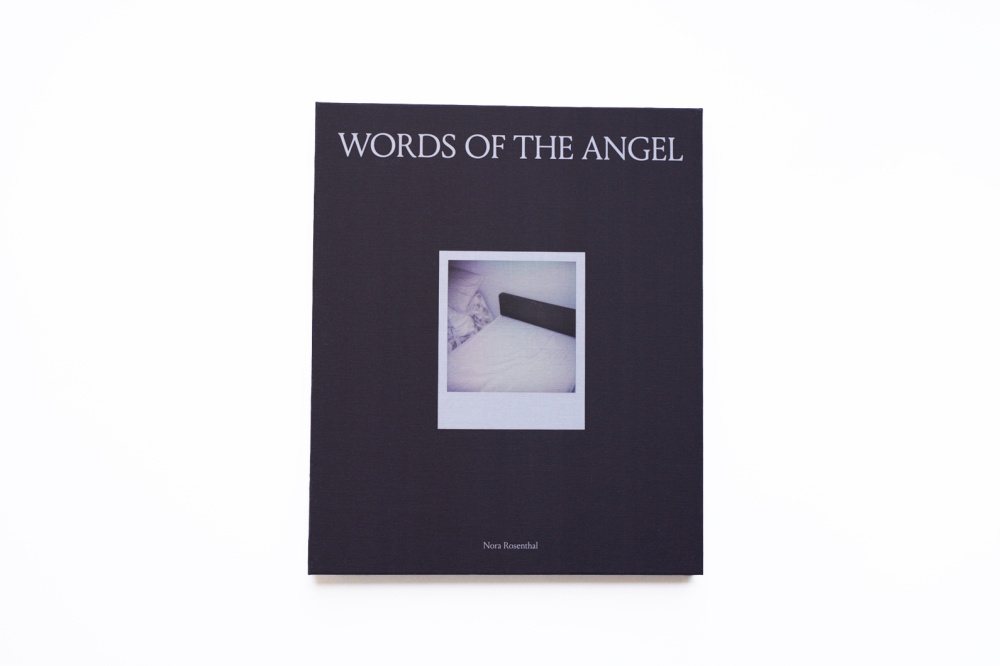
Words of the Angel
- Designer
- Emi Takahashi
- Artist
- Nora Rosenthal
- Date
- 2026
- Publisher
- Nora Rosenthal
- Format
- Artists' Books
- Genre
- Canadian, Poetry, Creative Writing , Photography
When my mom stopped chemotherapy I began taking photos, mostly Polaroids, of her, her and my dad, her and I, and sometimes just self portraits, as I was waiting around while she slept, thinking about how much my 33-year-old’s body looked like her 68-year-old one. Back then she joked that these photos would be “souvenirs of mommy.” She wasn’t wrong. She told me I could take a photo of her dead body, the way she took a photo of her mom’s dead body, the way I hope someone takes one of mine when my day comes.
We had recently made a film together about familial love, grief, and mortality – Nine Easy Dances – which would end up screening in 13 countries, but the months leading up to her death were much quieter, and photography gave us something creative to do together. Photography would also give me something to hang onto afterwards – at the crematorium, and as flowers arrived at the house, or under an apple tree where I would later pour some of her ashes. These needed, somehow, to be mostly Polaroids, so we could physically hold them, so we could hang out together waiting to see if the picture worked out. Moreover, it was only my Polaroid camera sturdy enough to sit on a counter, to take timed self-portraits at a moment that felt otherwise impossible to describe.
The texts that accompany these images came out of how my mom looked in death, while remembering the refrain we tell each other: your mom will always be with you. If so, how might you speak to an atomic mother – to the substance of the world that follows you, that enters you, that exits you? That is the fabric of yourself? After all, everything is born and dies and transforms. Even the earth, even the universe. Even a mother.
The title comes from “Annunciation (Words of the Angel)” (1902) by the poet Rainer Maria Rilke, who describes an angel lost in the world, whose message is muddied by physical space, by humanity, and by the telling of it. “You, my song’s most cherished ear,/ now I feel: my word got lost in you as in a wood.” We try to describe our most beautiful or even mystical visions, our ideas of the sublime, and we stumble, but the stumbling itself is still beautiful and necessary. This series of photographs, and this book, is my way of describing my love for my mother, and what it means to lose her.
—
Nora Rosenthal is a writer, filmmaker, and artist whose work has been supported by the Canada Council for the Arts, the NFB, and the Ontario Council for the Arts. She has participated in residencies through the Banff Centre, the RIDM, the Power Plant Contemporary Art Gallery, and UnionDocs in Brooklyn, NY. Formerly the Arts and Culture Editor at Cult MTL, her writing has appeared in Momus, MUBI’s Notebook, The Editorial Magazine and Documentary Magazine. Her short film Nine Easy Dances, nominated for Best Short Documentary by the International Documentary Association in 2024, has played at Visions du Réel, Dokufest Kosovo, and DOK Leipzig, among others, and screened at the Museo Guggenheim Bilbao. The film garnered two Best Director awards during its circuit, and a Jury Award at the Florence Short Film Festival. Since graduating with her MFA in Film Production from York University, she continues to work with researchers at York, and as a filmmaker-mentor with Wapikoni Mobile.
Related Items



- Art Metropole
- 896 College St
- Toronto, Ontario
- M6H 1A4 Canada
- +1 416 703 4400
- Hours:
- Tuesday to Sunday
- 11AM to 6PM
Art Metropole is a non-profit artist-run centre established 1974 as a division of Art-Official Inc. We are grateful for the support of the Canada Council for the Arts, the Ontario Arts Council, the City of Toronto through the Toronto Arts Council, as well as our donors, members and volunteers.
Your donation assists in the development of contemporary art practices and programs for the general public. Art Metropole is certified by the Ontario Living Wage Network.
- Toronto Arts Council
- Ontario Trillium Foundation
- Canada Council
- Ontario Arts Council
